A collaborative research team from Sun Yat-sen University Cancer Center (SYSUCC) and Southern University of Science and Technology (SUSTech) has achieved a significant breakthrough in developing a broad-spectrum weapon against oncogenic herpesviruses. Their findings, published as an Accelerated Article Preview in the prestigious journal
Nature on February 2, 2026, mark a major advancement in the fight against viruses linked to multiple cancers.

The study, titled "A broadly protective antibody targeting gammaherpesvirus gB," was co-led by Academician Mu-Sheng Zeng (Vice President of SYSUCC), Associate Professor Cong Sun from SYSUCC, and Prof. Zheng Liu from SUSTech. This work represents the team's second major breakthrough in Nature within a year, following their previous discovery of the EBV universal receptor R9AP.
Gammaherpesviruses, including the human oncogenic viruses Epstein-Barr virus (EBV) and Kaposi's sarcoma-associated herpesvirus (KSHV), are associated with various malignancies and autoimmune diseases. A major challenge has been the lack of effective vaccines or broad-spectrum neutralizing antibodies capable of combating different viruses within this subfamily.
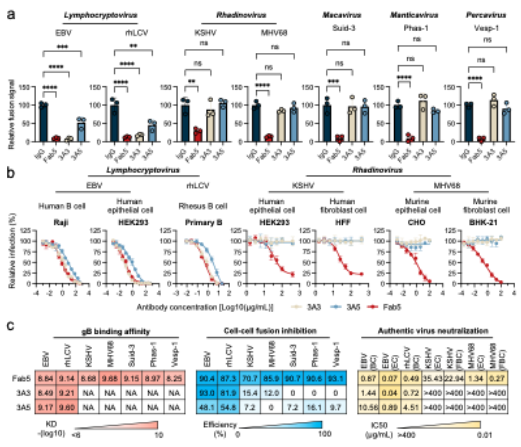
The research team successfully isolated a monoclonal antibody named Fab5, which targets the highly conserved fusion glycoprotein B (gB) essential for viral entry. Demonstrating unprecedented breadth, Fab5 effectively neutralized multiple gammaherpesviruses—including EBV, KSHV, and animal viruses like rhLCV and MHV68—both in laboratory tests and in animal models. In humanized mice co-infected with EBV and KSHV, Fab5 significantly improved survival and reduced viral loads. It also showed potent protective effects in models involving MHV68 in mice and rhLCV in cynomolgus monkeys.
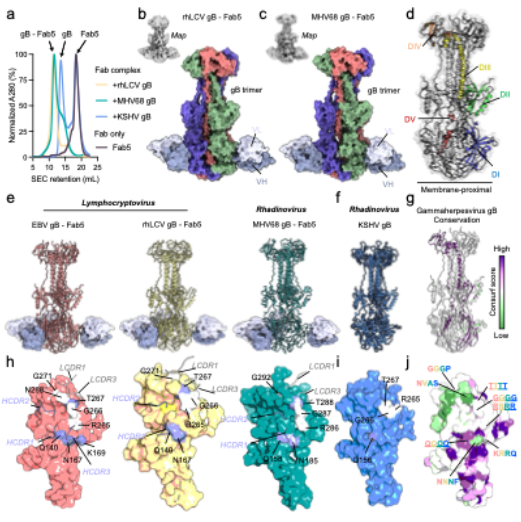
Using cryo-electron microscopy, the researchers revealed the structural mechanism behind Fab5's broad activity. The antibody binds to a conserved functional site on Domain I of the gB protein, a region critical for membrane fusion. This binding is believed to block essential conformational changes in gB or disrupt its interaction with other viral proteins, thereby inhibiting infection across different viruses.
This study provides the first direct evidence of a conserved, vulnerable site on gammaherpesvirus gB that can be targeted for broad intervention. The Fab5 antibody serves as a promising drug prototype, and the identified epitope offers a crucial blueprint for the rational design of next-generation broad-spectrum vaccines and antibody therapies against cancer-related herpesviruses.
The corresponding authors are Academician Mu-Sheng Zeng and Associate Professor Cong Sun from SYSUCC, and Prof. Zheng Liu from Southern University of Science and Technology. The co-first authors are Associate Professor Cong Sun, Postdoctoral Fellow Chu Xie from SYSUCC, and graduate student Bingzhen Cheng. This research was supported by the National Natural Science Foundation of China and the National Major Science and Technology Projects.
Link to the article: https://www.nature.com/articles/s41586-026-10192-5?sessionid=726485297