The International Guidelines and Atlas for Target Volume Delineation of Radiotherapy in Nasopharyngeal Carcinoma were officially released on September 2nd, 2025. Co-published in two parts—addressing the primary tumor and the neck—in the prestigious journal The Lancet Oncology, these Guidelines were developed under the leadership of
Prof. Ma Jun, Academician of the Chinese Academy of Sciences, along with
Prof. Sun Ying and
Prof. Tang Linglong from Sun Yat-sen University Cancer Center (SYSUCC). This effort represents a global collaboration involving 50 multidisciplinary specialists from 17 countries and regions.
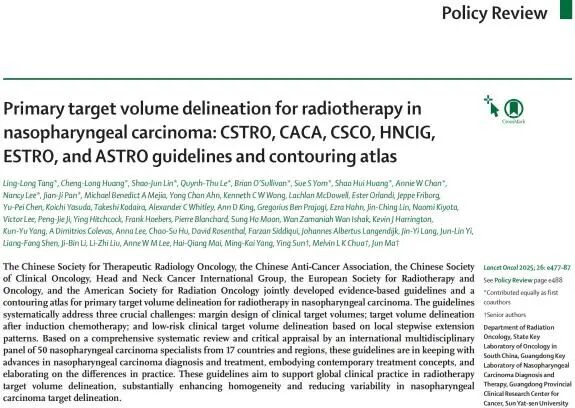
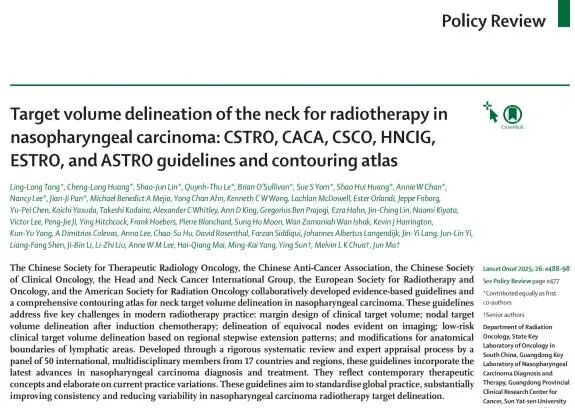
The Guidelines were jointly developed by the Chinese Society for Therapeutic Radiology and Oncology (CSTRO), the Chinese Anti-Cancer Association (CACA), the Chinese Society of Clinical Oncology (CSCO), the Head and Neck Cancer International Group (HNCIG), the European Society for Radiotherapy & Oncology (ESTRO), and the American Society for Radiation Oncology (ASTRO).
Addressing Key Clinical Challenges with Evidence-Based ConsensusThe primary tumor guidelines systematically address three crucial challenges: margin design of clinical target volumes, target volume delineation after induction chemotherapy, and low-risk clinical target volume delineation based on local stepwise extension patterns.
The neck guidelines provide solutions for five key areas: margin design of clinical target volume, nodal target volume delineation after induction chemotherapy, delineation of equivocal nodes on imaging, low-risk clinical target volume delineation based on regional stepwise extension patterns, and modifications for anatomical boundaries of lymphatic areas.
Developed through a rigorous systematic review and critical appraisal process by the international panel, these evidence-based guidelines embody contemporary treatment concepts and aim to support global clinical practice, substantially enhancing homogeneity and reducing variability in nasopharyngeal carcinoma radiotherapy target delineation.
Key Highlights: Precision, Inclusivity, and AccessibilityPrecision: Based on patterns of local invasion and lymphatic spread, the Guidelines offer systematic, individualized recommendations for target volumes. This approach enables effective tumor control while significantly reducing radiation doses to critical organs-at-risk, thereby mitigating common toxicities and enhancing patients' quality of life.
Inclusivity: The guidelines incorporate the latest advances in NPC diagnosis and treatment and elaborate on current practice variations, ensuring relevance across different healthcare settings.
Accessibility: To facilitate global implementation, the Guidelines include a comprehensive contouring atlas with high-resolution, multi-sequence fused images for the primary site and neck. These annotated images provide clinicians with clear, visual, and practical guidance to ensure consistency and accuracy.
International AcclaimThe Guidelines have received high praise from international experts. Lisa Bradfield, Senior ASTRO Guidelines Manager, commended the work. Esteemed professors from leading institutions worldwide unanimously acknowledged the Guidelines' significance, describing the international collaboration as "an invaluable educational resource for radiation oncologists globally." The Guidelines will be promoted globally through the official channels of ASTRO, ESTRO, and other international societies.
Chinese Scholars as International Standard-SettersChina accounts for 47% of global NPC cases. For over two decades, Academician Ma Jun's team has focused on enhancing efficacy and reducing toxicity in NPC treatment, achieving multiple breakthroughs that have influenced national and international guidelines. This leadership role in developing an international, multi-society guideline signifies that Chinese scholars have become established standard-setters in the field. The Guidelines promise more precise and personalized treatment for NPC patients worldwide, advancing care from merely ensuring survival towards optimizing quality of life.
Links to Publications in The Lancet Oncology:Primary Tumor:
https://www.thelancet.com/journals/lanonc/article/PIIS1470-2045(25)00326-2/fulltextNeck:
https://www.thelancet.com/journals/lanonc/article/PIIS1470-2045(25)00327-4/fulltext