
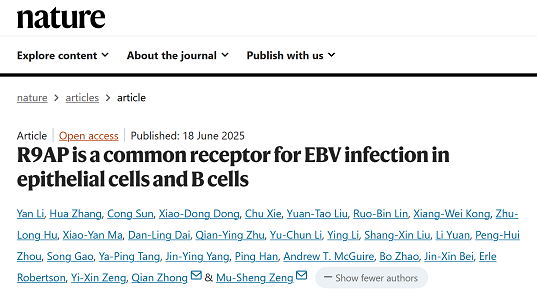
A landmark study published online in Nature on June 18, 2025, by researchers from Sun Yat-sen University Cancer Center (SYSUCC) has identified a universal receptor critical for Epstein-Barr virus (EBV) infection in both epithelial cells and B cells. This discovery, led by Prof. Musheng Zeng and Prof. Qian Zhong, overturns a long-standing paradigm in virology and opens new avenues for developing effective antiviral vaccines.
The research, titled "R9AP is a common receptor for EBV infection in epithelial cells and B cells," solves a fundamental mystery surrounding EBV, a ubiquitous human herpesvirus linked to numerous diseases. These include infectious mononucleosis (IM), chronic active EBV infection (CAEBV), multiple sclerosis (MS), rheumatoid arthritis, systemic lupus erythematosus, and several cancers such as nasopharyngeal carcinoma, EBV-associated gastric cancer, and various lymphomas (NK/T-cell, peripheral T-cell, Hodgkin's, and Burkitt's lymphoma).
EBV primarily infects B lymphocytes and epithelial cells. While the receptor for B cell infection (CR2/CD21) was identified in 1984, and HLA II was later found to mediate fusion, understanding how EBV infects epithelial cells proved extremely challenging. EBV infects cultured epithelial cells inefficiently, stalling research for decades. Prof. Zeng's team previously overcame this hurdle by developing several novel, highly efficient in vitro EBV infection models, such as using BMI-1 immortalized nasopharyngeal epithelial cells grown in spheres.
Building on these models, the team had already discovered key epithelial receptors: NMHC-IIA (mediating adhesion), NRP1 (mediating internalization), and EphA2 (triggering fusion). However, a critical question remained: since the viral gH/gL and gB glycoproteins are essential for infecting all cell types, and antibodies against gH/gL block infection in both B cells and epithelial cells, could there be a common receptor enabling EBV entry into both major host cell types?
Prof. Musheng Zeng and Prof. Qian Zhong from Sun Yat-sen University Cancer Center are the co-corresponding authors of the paper. Co-first authors are Associate Chief Physician Yan Li (SYSUCC), Associate Professor Hua Zhang (School of Medicine, Sun Yat-sen University), Dr. Cong Sun (SYSUCC), and Dr. Xiaodong Dong (SYSUCC). The research was funded by the National Natural Science Foundation of China, among others.
Copyright:Sun Yat-sen University Cancer Center Designed by Wanhu.